Report Summary
Highlights of key results for the status report summarizing land cover and biodiversity indicators in the Alberta Pacific Forest Products Inc. Forest Management Agreement area.
.svg)
Area of Analysis
- Al-Pac primarily harvests deciduous trees (Trembling Aspen, Balsam Poplar) in its FMA area, but in some Forest Management Units they also have tenure over coniferous trees.
- In most of the FMA area, timber quotas for coniferous trees are held by eight other forestry companies.
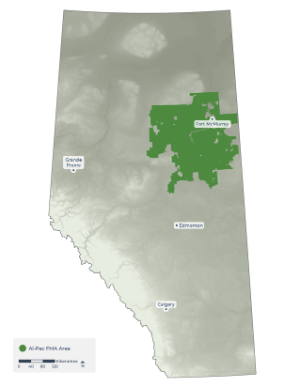
Area of Analysis. Location of the Al-Pac FMA area in Alberta highlighted in green.
Methods
The ABMI has 153 permanent monitoring sites in Al-Pac's FMA area, all of which have been surveyed as of 2023. At each location, ABMI technicians recorded the species present, and measured a variety of habitat characteristics. Methods for ABMI indicators are summarized under three themes:
- Natural landscape indicators: native vegetation, native cover, interior native habitat, and landscape connectivity.
- Land base change indicators: human footprint, land base change, forest age, and linear feature density.
- Biodiversity indicators: Biodiversity Intactness Index, sector effects, and land base change attribution.
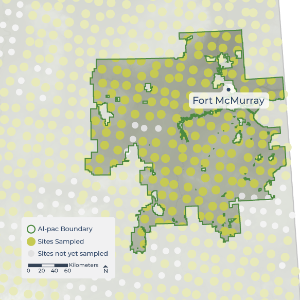

Monitoring Sites. ABMI's monitoring sites within Al-Pac's FMA area.
Chapter 2 Highlights: Status of the Natural Landscape
Introduction and Overview
Documenting and mapping vegetation types over time is critical to understanding how human activity, including forestry, is affecting ecosystems, and to supporting sustainable, evidence-based land-use decisions. In Chapter 2 of this report, we summarize status and trend of the natural landscape within Al-Pac's FMA area:
- We summarize the current native vegetation native cover types, and how they have changed since 1950.
- We discuss current conditions and change in interior habitat—native vegetation that is away from human footprint.
- Landscape connectivity is explored to understand how it is impacted by human footprint.
- Finally, research results are presented that compare characteristics between harvest retention patches and wildfire islands.
Key results are shown below.
Tracking vegetation types is important to understand how human activities are impacting habitat loss or changes in vegetation composition. The change in vegetation cover between 2000 and 2023 varied according to stand type and age.
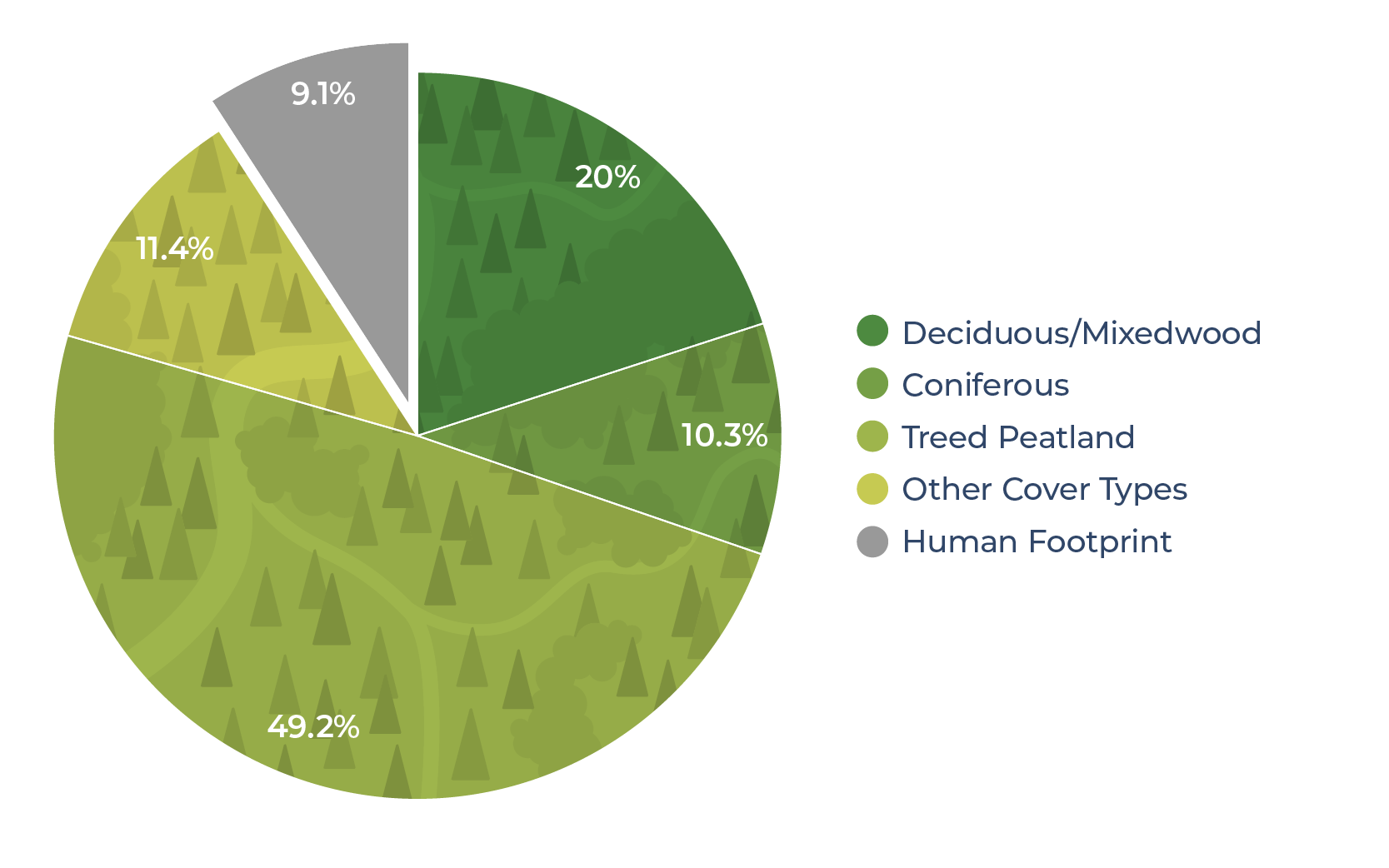
- As of 2023, undisturbed native vegetation made up 90.9% of the land base.
- Undisturbed upland forests (where most harvesting occurs) cover just over 30% of the area.
- Deciduous forest was the most affected by disturbance, declining by 2.3 percentage points since 2000.
- Among forests >100 years old (2000–2023): deciduous and Pine stands increased; mixedwood stands remained stable; White Spruce stands declined.
Native cover—land free from visible human use—is vital for biodiversity and ecosystem function, but is increasingly converted by human activities to other land uses. Native cover is expressed as a percentage relative to a reference state with no human footprint. The status of undisturbed native vegetation as of 2023 was:
- Terrestrial cover is 86.8% compared to a reference state, decreasing by 3.7 percentage points since 2010. Currently, undisturbed terrestrial habitat covers 26,630 km²—41.8% of the FMA area.
- Aquatic and wetland cover decreased by 0.9 percentage points, with current cover being 97.1% relative to an undisturbed reference state. Currently, undisturbed lowland habitat covers 32,082 km2—50.4% of FMA area.

Human footprint can have effects beyond the area it occupies. We summarized current conditions and change in interior habitat:
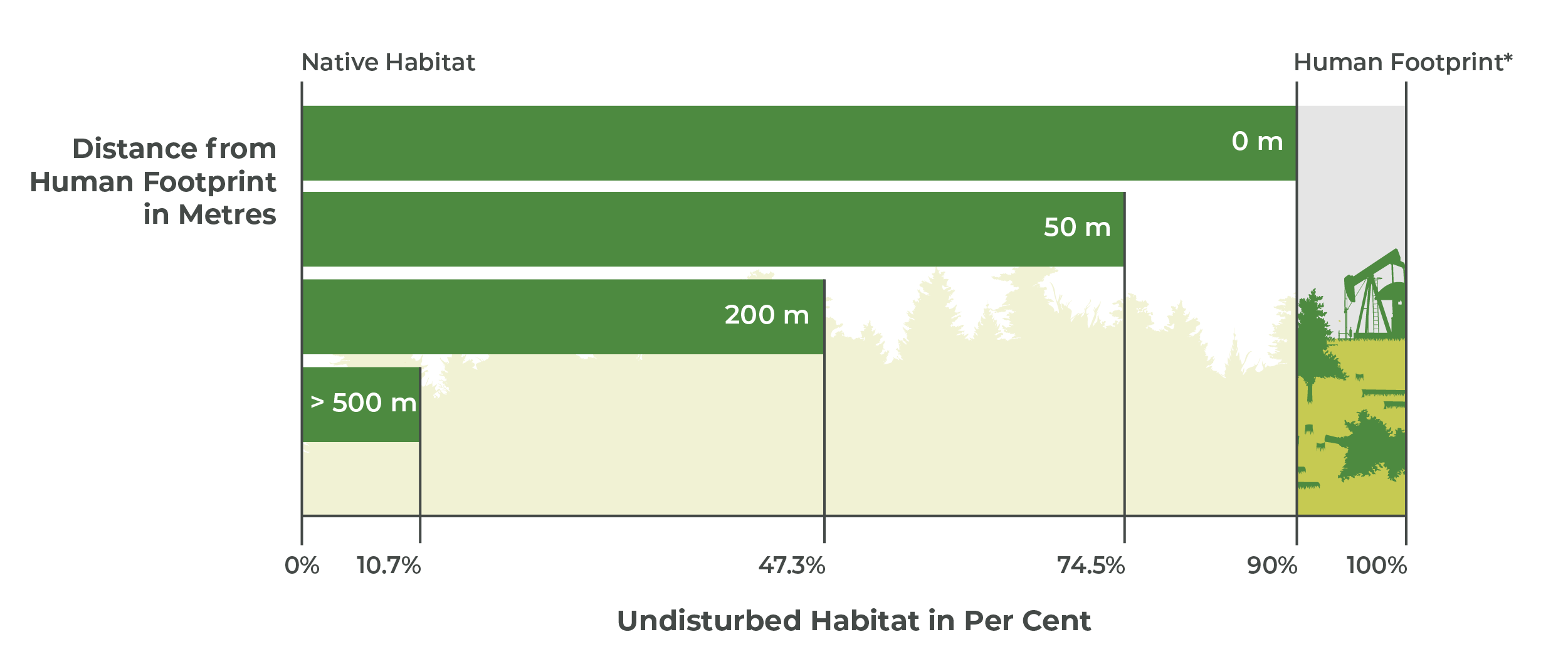
- Interior native habitat made up 74.5%, 47.3%, and 10.7% of the landscape at distances of 50 m, 200 m and 500 m from human footprint, respectively.
- Losses were greatest in deeper interior areas (200–500 m and >500 m), particularly in White Spruce, mixedwood, and deciduous stands.
Landscape connectivity refers to the degree to which landscapes facilitate or impede the movement of species between patches of natural habitat. The impacts of human footprint on landscape connectivity is summarized for two broad habitat categories:
- Terrestrial habitat connectivity was 49% in 2022, a decrease of 2 percentage points since 2010.
- Aquatic and wetland habitat connectivity has seen a greater reduction, from 46% in 2010 to 41% as of 2022.
Research Spotlight: Do Harvest Patches Mimic Natural Disturbance Patterns?
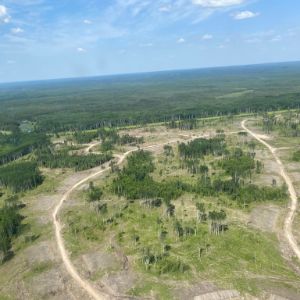
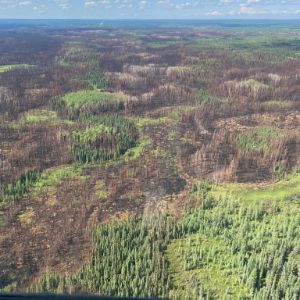
We present research led by Dr. Charles Nock and collaborators at the University of Alberta. Research studies compared forest characteristics of wildfire islands and harvest retention patches, including tree mortality, deadwood, and understory plant communities. Their findings indicate that retention patches can maintain some ecological functions similar to those of wildfire islands.
Chapter 3 Highlights: Summary of Land Base Change
Introduction and Overview
The expansion of human footprint and the resulting disturbance to native ecosystems remain key pressures on biodiversity in the boreal forest. In addition to these human influences, natural processes such as wildfire and forest aging continue to shape habitat composition and structure on the landscape. In Chapter 3 of this report, we evaluate how human footprint, wildfire, and linear feature density are influencing native habitat condition within Al-Pac’s FMA area.
- We summarize the current extent and composition of human footprint by type and describe how these footprints have changed since 1950.
- The most recent decades are examined in greater detail, highlighting how human footprint, natural disturbance, and the aging of undisturbed forest have altered vegetation composition between 2010 to 2023.
- Finally, we assess the density of linear features, which occupy relatively small areas but have a disproportionately large effect on interior habitat compared to other forms of human disturbance.
Key land cover results are shown below.
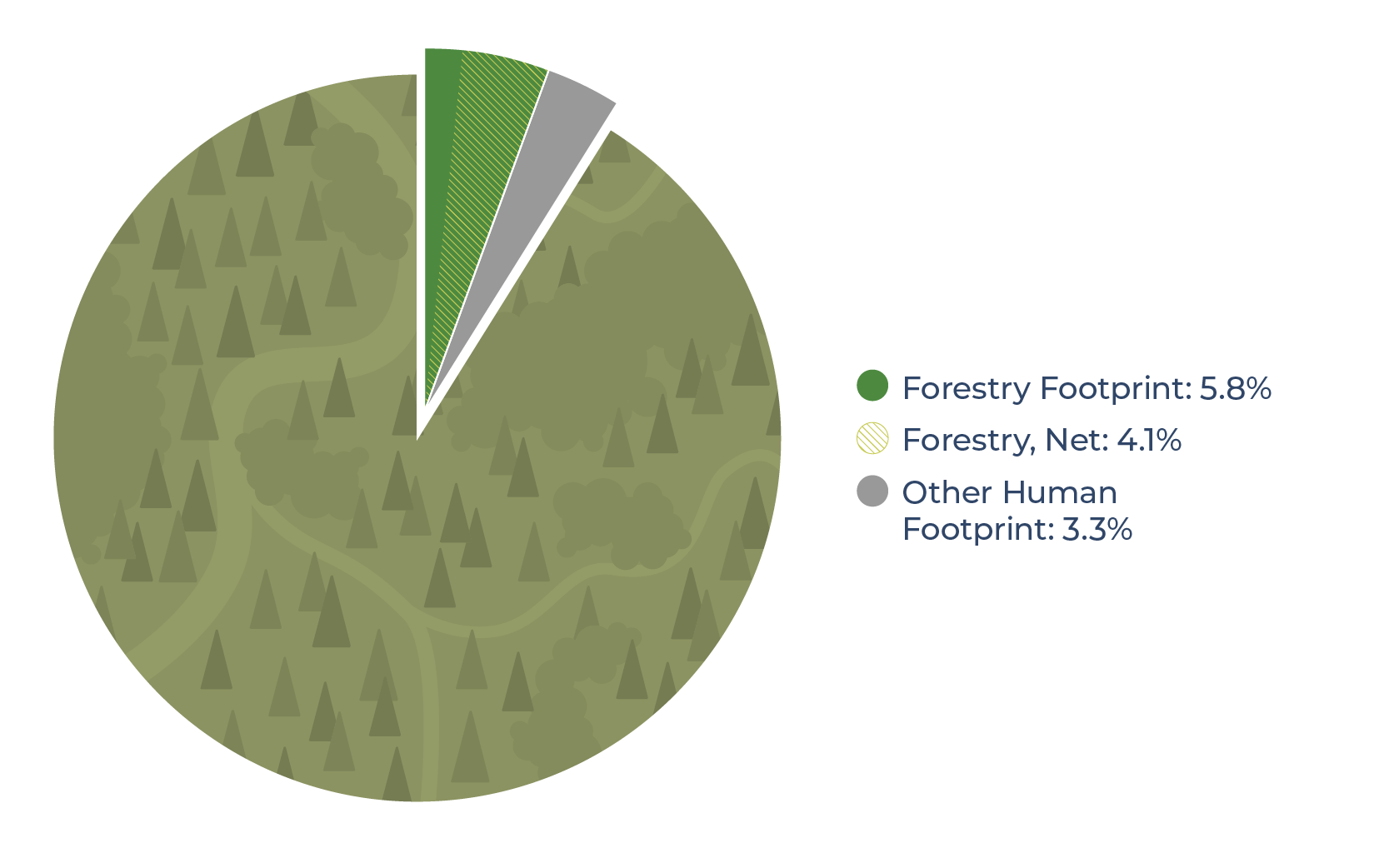
As of 2023, total human footprint in Al-Pac’s FMA area was 9.1%, up from 4.4% in 2000—an overall increase of 4.7 percentage points.
- Forestry was the largest contributor, representing 5.8% of the area, followed by the energy sector (2.4%), with all other footprint types each covering less than 1%.
- Forestry footprint increased by 2.9 percentage points since 2000 (from 2.9% to 5.8%), though when regenerating harvested areas are accounted for, net forestry footprint rose by 1.5 percentage points (from 2.6% to 4.1%).
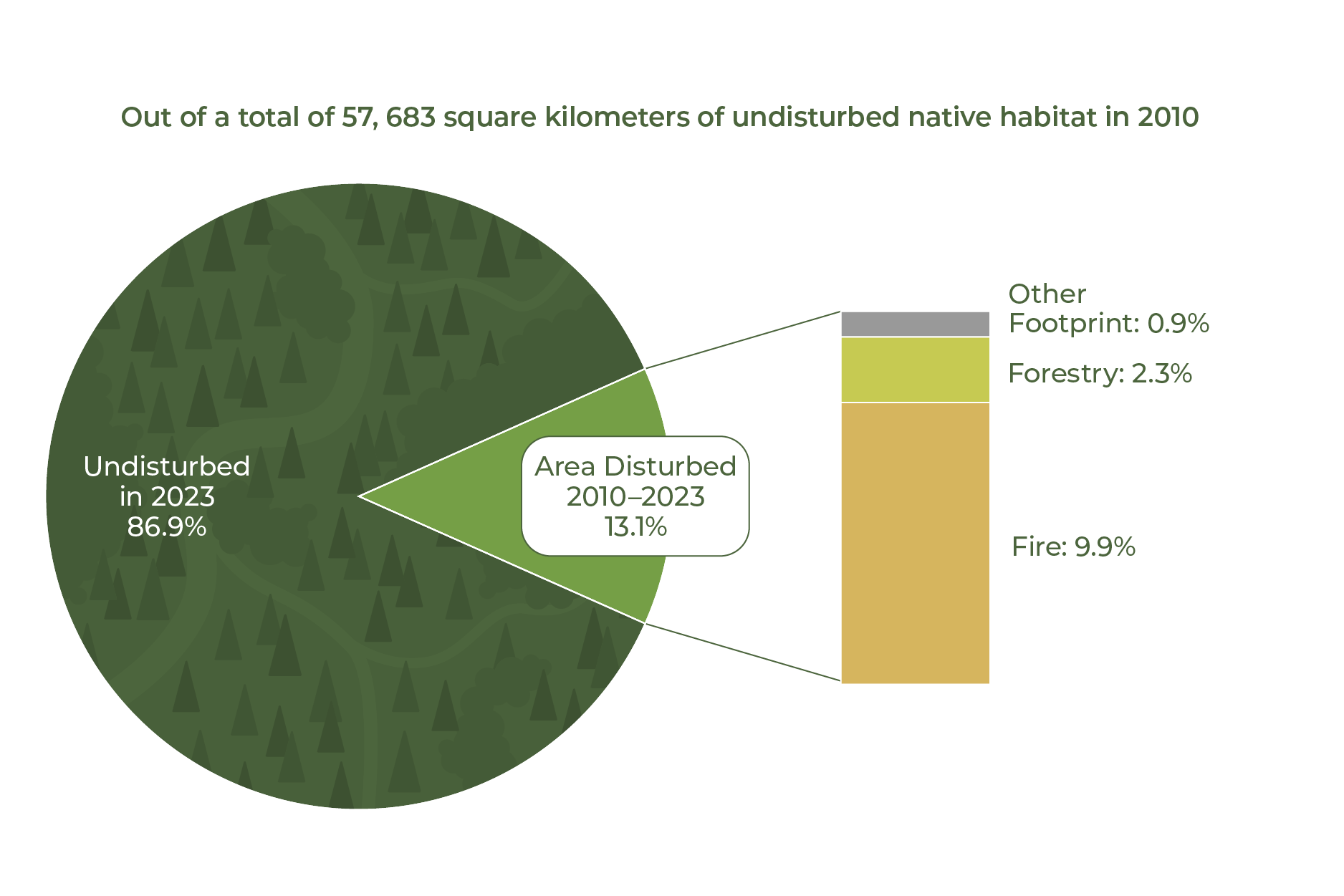
We looked in more detail at how land base changes due to human footprint and fire, as well as the aging of undisturbed forest, affected the distribution of vegetation types in the Al-Pac FMA area between 2010 and 2023.
- The per cent of native vegetation disturbed by human footprint and fire was 13% between 2010 and 2023.
- The vegetation types most affected by the combined impacts of fire and human activity were pine and White Spruce at ≅26% disturbance.
- Fire on its own contributed 8–23% of the disturbance in upland forest types.
- Between 2010 and 2023, old forest (100+ years) in the Al-Pac FMA increased by 6% as maturing stands offset losses from land use and fire.
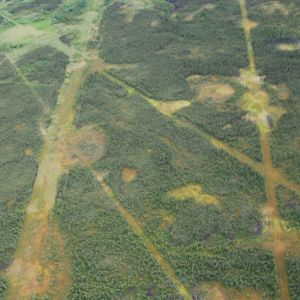
Being widespread across the landscape, linear footprint has a large effect on the amount of interior habitat in the region. As of 2023, the linear footprint density in Al-Pac's FMA area was:
- 1.9 km/km2 (126,566 km total length) for all linear feature types combined.
The most common line types were:
- 1.2 km/km2 (81,106 km) for conventional seismic lines, representing 64% of line types.
- 0.3 km/km2 (16,127 km) for other linear features, representing 13%.
- 0.2 km/km2 for pipelines (13,896 km) and roads (13,470 km), each representing 11% of total line types.
Chapter 4 Highlights: Status of Biodiversity
Introduction and Overview
Identifying species most affected by land-use changes is essential for effective land-use planning and developing targeted mitigation strategies when needed. However, with multiple industries operating within the same area, isolating the specific impacts of each industry on various species can be challenging. Additionally, natural disturbances, particularly wildfires, further alter habitats and complicate the understanding of species' responses.
In Chapter 4 of this report, we report on how human footprint and other land base changes impact the habitat suitability for species in the Al-Pac FMA area:
- The Biodiversity Intactness Index is used to summarize the overall effects of human footprint on the habitat suitability of species in the region.
- To understand how different human activities are impacting habitat suitability, we summarize the local and regional effects of different types of human footprint (i.e., energy, forestry, transportation, and urban/industrial) on habitat suitability for species.
- Finally, we examine how human footprint, natural disturbance, and aging of undisturbed forest affected habitat suitability for species, from 2010 and 2023.
Key results for biodiversity are shown below.
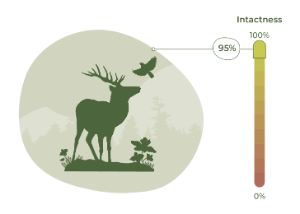
The ABMI assessed the overall intactness of 656 common species in Al-Pac's FMA area and found the Biodiversity Intactness Index to be 95%.
- Intactness was high for all groups ranging from 93% for vascular plants to 97% for mammals.
- Despite generally high intactness, every group except mammals included species whose intactness declined more than expected based on the amount of human footprint in the region. Species associated with mature forests showed the greatest declines in habitat suitability.
- Many generalist species had increased in habitat suitability, often benefiting from human footprint or able to use both native habitat and disturbed areas.
Effects of Human Footprint on Habitat Suitability
The ABMI assessed the impacts of human footprint from four different sectors—energy, forestry, transportation, and urban/industrial—on six taxonomic groups in the Al-Pac FMA area.
- Habitat suitability was lower within human footprint compared to the native vegetation it replaced for 69% of species across six taxonomic groups.
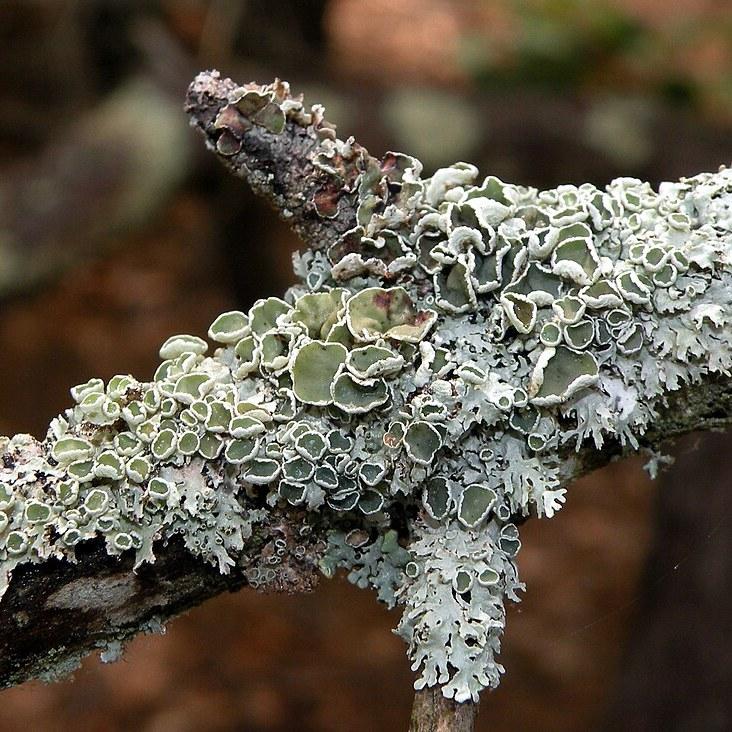
- Lichens and mosses were the groups most negatively affected by human footprint.
- Forestry had greater negative effects on species reliant on old, upland forest stands.
- All sectors increase habitat suitability for species associated with open and/or disturbed habitat.
Effects of Land Base Change on Habitat Suitability
Effects on habitat suitability were assessed for different types of land base change: forestry, non-forestry human footprint, fire, and aging of undisturbed stands.
- Overall, 42% of species had net declines in habitat suitability driven by both natural changes and human footprint.
- The net effect of natural changes on the land base, including fire and aging of naturally disturbed stands, was, on average, greater than the net effect of human footprint.
- New forestry footprint reduced habitat suitability for 66% of species. This was partially offset by aging of older harvested areas.

Chapter 5 Highlights: Species of Management Interest
Many species’ habitat needs are addressed through coarse-filter management strategies, such as maintaining a natural range of forest age classes and types across the landscape—patterns that emulate those created by wildfire. However, some species require more targeted, fine-filter management. Chapter 5 highlights species that need specific management attention within the Al-Pac FMA area, including:
- A summary of species of conservation concern, showing per cent occurrence and biodiversity intactness for more commonly detected species.
- The number and status of non-native vascular plant species recorded at sampled sites, including identification of noxious weeds.
- Updates on caribou habitat recovery, including tools used to monitor restoration progress within and adjacent to caribou ranges.
- Results from two research studies assessing bird responses to human footprint: one examining fragmentation effects on old-forest warblers, and another evaluating songbird use of harvest retention patches.
Key results are shown below.
31 species at risk are tracked by Al-Pac in the FMA area, including 18 bird species, 8 mammals, and 5 species of amphibians, fish, and invertebrates. 15 of these species were detected by ABMI.
- Of the eight species that are common enough to allow for the calculation of intactness scores, habitat suitability was lower than expected compared to reference conditions for six species, and similar to reference conditions for three species.
- The species with the biggest declines in habitat suitability were all old-forest dependent species.
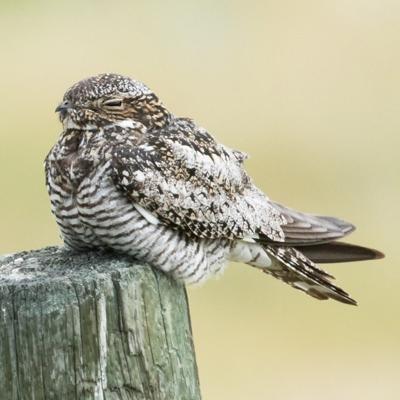
We assessed the presence of non-native plants in Al-Pac's FMA area and found 51 species of non-native vascular plants.
- Of these, 7 species are designated as noxious weeds under Alberta’s Weed Control Act.
- Non-native species were detected at 46.0% of sites, with an average of 7 species at sites where they were found.
Restoring habitat is critical for boreal Woodland Caribou population recovery in Alberta. This section highlights ongoing work that uses lidar and machine learning to map vegetation regrowth on legacy and low-impact seismic lines. These tools provide a way to monitor habitat recovery and guide restoration efforts in caribou ranges.

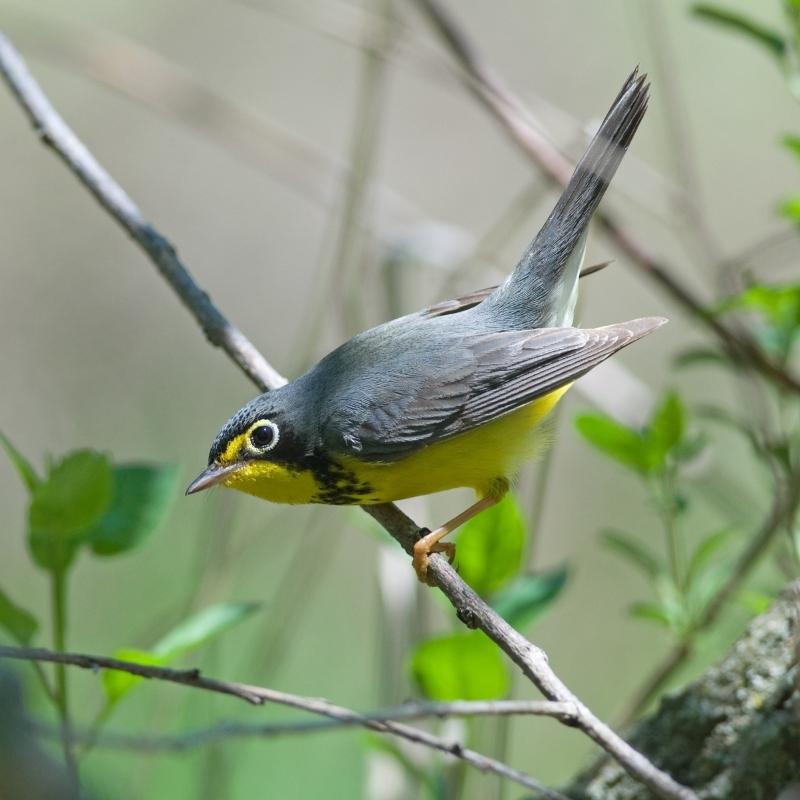
This section summarizes results from PhD research conducted by Taylor Hart at the University of Alberta. The study examined how habitat loss and fragmentation affect two old-forest songbirds in Alberta’s boreal forest—the Canada Warbler and Black-throated Green Warbler. Both species declined with increasing habitat loss and fragmentation, underscoring the importance of maintaining large, connected tracts of mature forest to sustain old-forest specialists.
This section summarize PhD research conducted by Isabelle Lebeuf-Taylor at the University of Alberta. Retention patches within regenerating harvest areas introduce structural and compositional heterogeneity that are beneficial for wildlife. This study explored how variable retention in regenerating harvests may speed up forest bird use of harvested areas. Results show that any amount of retention is valuable for some songbirds, but benefits take a minimum of 10 years to come into effect.